

- By Jaxin
- July 9, 2026
- Amazon FBA
Many exporters face a common challenge when shipping goods by rail: their 40-foot high cube containers often leave warehouses with unused space, uneven cargo distribution, or inefficient packaging arrangements. Although 40HC containers provide additional height compared with standard containers, poor planning can increase transportation costs and create safety risks during China-Europe rail shipments.
Moreover, companies shipping electronics, machinery parts, consumer goods, or industrial products need a better way to balance cargo volume, weight limits, and loading efficiency. Therefore, improving container utilization before departure can significantly reduce unnecessary expenses and avoid loading-related problems.
This guide explains practical methods for optimizing high cube container loading, including cargo measurement, weight distribution, pallet arrangement, and professional planning strategies. By applying these solutions, businesses can achieve safer transportation, lower freight costs, and more reliable international supply chain operations.

What Is 40HC Rail Freight Loading Optimization and Why Does It Matter?
40HC container loading optimization refers to the process of planning cargo arrangement inside a 40-foot high cube container to maximize available volume while maintaining safety, stability, and compliance.
A standard 40HC container provides approximately 76 cubic meters of internal space. However, actual usable capacity depends on cargo dimensions, packaging design, weight limits, and loading methods.
Moreover, rail transportation creates different requirements compared with ocean shipping because cargo experiences repeated handling during terminal transfers, rail movement, and last-mile delivery.
| Factor | Impact on Rail Freight |
|---|---|
| Cargo dimensions | Determines stacking efficiency |
| Packaging structure | Influences available loading space |
| Weight distribution | Affects transportation safety |
| Loading sequence | Reduces unloading difficulties |
| Container utilization | Directly impacts freight cost |
Additionally, optimized loading helps companies avoid paying for unused container space. For example, if a 40HC container is only 75% utilized, the cost per product unit increases significantly.
NOTE:Therefore, companies shipping automotive parts, machinery components, electronics, furniture, or consumer goods should develop a structured loading strategy before cargo reaches the warehouse.
How Can 40HC Rail Freight Loading Optimization Reduce Shipping Costs?
Poor container planning often increases logistics expenses because companies pay for the entire container regardless of whether the available space is fully used.
However, effective 40HC container utilization planning can reduce costs by improving cubic utilization and decreasing the number of containers required.
For example, businesses can combine different carton sizes, adjust pallet dimensions, or redesign packaging to fit container dimensions more efficiently.
| Loading Strategy | Cost Impact | Benefit |
|---|---|---|
| Optimize pallet size | Reduce unused space | More cargo per container |
| Use stackable packaging | Increase vertical utilization | Higher cubic efficiency |
| Pre-calculate cargo layout | Reduce loading mistakes | Faster warehouse operation |
| Consolidate shipments | Lower container quantity | Reduced freight spending |
Furthermore, companies should calculate cargo volume before booking rail transportation.
The basic calculation method is:
Container utilization rate = Cargo volume ÷ Container usable volume × 100%
A higher utilization rate means a lower transportation cost per cubic meter.
Additionally, freight teams should consider weight rather than volume alone. Heavy products may reach weight limits before using the full container capacity.
Therefore, balancing volume and weight is essential for achieving the best loading efficiency.
What Factors Affect 40HC Container Loading Efficiency?
Several factors influence whether a 40HC container can achieve maximum loading efficiency. Moreover, each cargo type requires a different loading approach.
Cargo Dimensions and Packaging Design
Cargo size is one of the most important factors. Irregular products often create empty spaces, while standardized cartons are easier to stack.
Additionally, oversized packaging can reduce container efficiency even when the actual product volume is small.
Weight Distribution and Safety
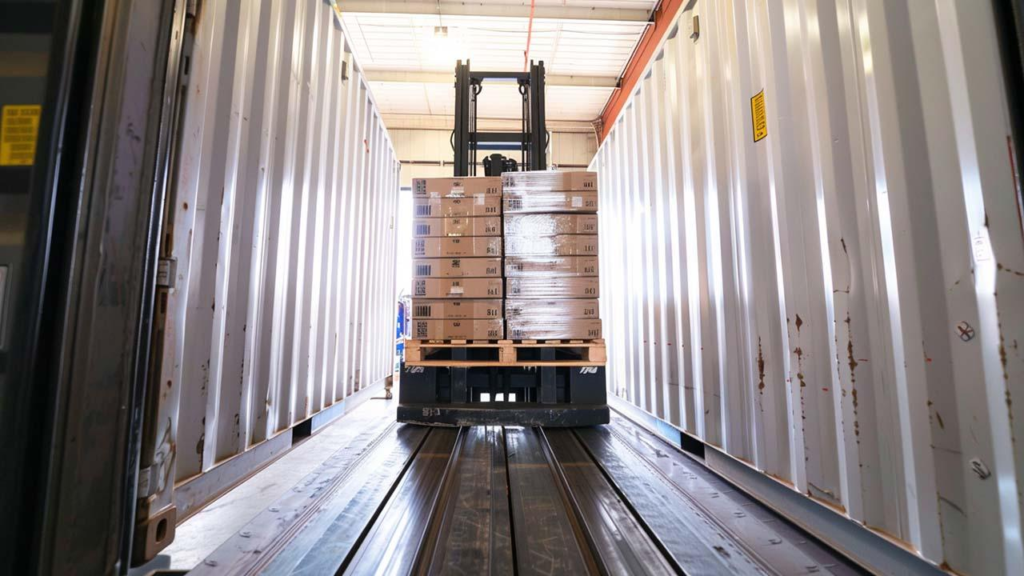
Although 40HC containers offer large capacity, cargo must be distributed evenly.
| Loading Issue | Possible Risk | Solution |
|---|---|---|
| Heavy cargo placed at one side | Container imbalance | Spread weight evenly |
| Fragile goods under heavy items | Product damage | Separate cargo layers |
| Empty gaps between pallets | Cargo movement | Use filling materials |
Furthermore, rail transportation involves vibration and acceleration forces. Therefore, proper securing methods such as straps, airbags, and protective materials are necessary.
Loading Sequence Planning
Meanwhile, loading order also affects delivery efficiency. Cargo needed first during unloading should be placed near the container door.
Consequently, a detailed loading map helps warehouse teams save time and reduces the possibility of cargo damage.
How to Calculate the Best 40HC Container Loading Plan?
A professional loading plan combines volume calculation, weight analysis, and cargo arrangement before shipment preparation begins.
However, many companies only estimate container space after production is completed. This approach often causes inefficient loading and additional logistics costs.
A better approach includes the following steps:
| Step | Action | Purpose |
|---|---|---|
| 1 | Measure cargo dimensions | Confirm available space |
| 2 | Calculate total volume | Estimate container requirements |
| 3 | Check cargo weight | Avoid overweight problems |
| 4 | Create loading layout | Improve space utilization |
| 5 | Test stacking method | Reduce damage risks |
Moreover, digital loading simulation tools can help companies visualize cargo placement before physical loading.
For example, if a shipment contains multiple carton sizes, a loading simulation can identify the best arrangement and prevent unnecessary empty areas.
Additionally, companies should consider future shipment frequency. A standardized loading model can be reused for repeated rail freight shipments, improving operational efficiency.
Therefore, calculating a detailed loading plan before transportation is one of the most effective ways to improve 40HC container loading optimization results.
How Do Professional Services Improve Container Loading Efficiency?
Although many companies can arrange basic container packing, professional logistics providers offer more advanced 40hc rail freight loading optimization solutions by combining cargo analysis, route experience, and compliance knowledge.
Moreover, experienced freight teams understand the challenges of China-Europe rail transportation, including terminal handling requirements, weight restrictions, and customs procedures.
A professional loading service usually includes:
| Service | Purpose | Business Benefit |
|---|---|---|
| Cargo measurement analysis | Identify exact dimensions and weight | Prevent inefficient loading |
| Container layout design | Create optimized loading plans | Increase capacity usage |
| Pallet configuration advice | Improve stacking efficiency | Reduce wasted space |
| Weight distribution planning | Balance cargo inside container | Improve transport safety |
| Loading supervision | Ensure correct execution | Reduce shipment risks |
Additionally, professional providers can recommend whether a full 40HC container, shared container solution, or multimodal transport option is more suitable.
For example, lightweight but bulky products may benefit from maximizing cubic capacity, while heavy machinery parts may require stricter weight planning.
Furthermore, logistics experts can combine 40HC container utilization improvement with customs documentation preparation. Consequently, shipments are less likely to experience delays caused by incorrect cargo information.
Therefore, working with an experienced rail freight partner is especially valuable for companies shipping regularly between China and Europe.
What Are Common Mistakes in 40HC container loading optimization?
Even when companies use high cube containers, several mistakes can reduce loading efficiency and increase transportation risks.
However, most problems can be avoided through early planning and professional inspection.
| Common Mistake | Impact | Recommended Solution |
|---|---|---|
| Loading without volume calculation | Low container utilization | Prepare loading plans before shipment |
| Ignoring weight limits | Potential compliance problems | Check gross weight requirements |
| Using unsuitable pallets | More empty space | Adjust pallet dimensions |
| Mixing fragile and heavy goods | Cargo damage risk | Separate cargo categories |
| Poor cargo securing | Movement during transit | Use proper fastening materials |
Additionally, some exporters focus only on fitting more products into the container but ignore unloading requirements.
For example, cargo packed too tightly may become difficult to access at the destination warehouse, causing additional handling costs.
Moreover, incorrect loading sequences may create delays during terminal operations.
Therefore, optimization should not only focus on maximizing space but also consider safety, accessibility, and transportation regulations.
A balanced loading strategy helps companies achieve better results throughout the entire supply chain.
Case Study: Improving 40HC Container Utilization for Electronics Export
📦 Case Card: Improving Container Utilization for Electronics Cargo
🚢 Route
Shenzhen, China → Warsaw, Poland
📦 Cargo
Electronic control panels and accessories
⏱ Transit Time
18 days via China-Europe Railway Express + trucking
💰 Cost Impact
Reduced freight cost by approximately 12% after container optimization
🚆 Transportation Method
China-Europe Railway Express + European last-mile delivery
🛃 Customs Clearance Details
HS code verification completed before shipment. Commercial invoice and packing list were checked to avoid customs documentation issues.
⚠️ Challenge
The exporter previously used two containers because poor carton arrangement created large unused spaces inside the 40HC container.
✅ Optimization Solution
- Adjusted pallet dimensions to improve vertical space utilization
- Reorganized cargo sequence based on weight and unloading requirements
- Added securing materials to reduce movement during rail transportation
📈 Result
Container utilization increased from around 72% to over 90%, while freight expenses and warehouse handling time were reduced.


How Can Businesses Improve 40HC container loading optimization for Different Cargo Types?
Different products require different loading strategies. Therefore, companies should avoid using one standard method for every shipment.
| Cargo Type | Recommended Loading Method | Main Consideration |
|---|---|---|
| Electronics | Anti-static packaging and organized stacking | Prevent damage |
| Machinery parts | Heavy items at the bottom | Maintain weight balance |
| Furniture | Modular packing and vertical stacking | Maximize volume |
| Consumer goods | Carton standardization | Improve loading speed |
| Automotive components | Pallet-based organization | Simplify unloading |
Moreover, cargo packaging improvements can significantly influence container efficiency.
For instance, reducing unnecessary packaging layers may create additional loading space without changing product quantity.
Additionally, companies with regular shipments should record successful loading patterns and create standard operating procedures.
Therefore, continuous improvement rather than one-time adjustment provides better long-term results.
Conclusion
Effective 40hc rail freight loading optimization helps companies maximize container capacity, reduce transportation costs, and improve shipment safety. Moreover, proper cargo measurement, weight distribution, pallet planning, and professional loading support can significantly improve China-Europe rail freight efficiency.
By applying structured loading strategies, businesses can avoid wasted container space and achieve more reliable international transportation performance.
Request a customized loading assessment before your next shipment to discover how optimized container planning can reduce costs and improve rail freight efficiency.
Improve your container utilization and reduce rail freight costs with expert loading planning support for China-Europe shipments.
FAQ:
Q1.How much cargo can fit in a 40HC rail freight container?
A standard 40HC container provides around 76 cubic meters of space. However, actual capacity depends on cargo dimensions, packaging methods, pallet size, and weight limitations.
Q2.Can 40HC loading optimization reduce rail freight costs?
Yes. Optimized container loading increases space utilization and may reduce the number of containers required, lowering overall transportation costs.
Q3.What documents are needed for optimized rail freight loading?
Typically, companies need packing lists, commercial invoices, cargo dimensions, weight information, and customs documents such as HS code details.
Q4.Is rail freight suitable for oversized or heavy cargo?
Rail freight can handle many heavy shipments. However, companies should check container weight limits and use professional loading plans to avoid overweight risks.
Q5.How can I choose a freight forwarder for optimized rail container loading solutions?
Choose providers with China-Europe rail experience, cargo planning capabilities, customs knowledge, and proven solutions for improving container utilization.