

- By Jaxin
- July 14, 2026
- Amazon FBA, Service
Introduction
Multimodal rail freight with final truck delivery service is becoming a preferred logistics solution for importers, retailers, and manufacturers seeking efficient transportation across international markets. While rail freight offers fast and cost-effective long-distance transportation, many destinations still require local trucking to complete the final delivery.
Moreover, relying on a single transportation mode may create limitations in coverage and flexibility. Therefore, combining rail and truck transportation enables businesses to improve transit efficiency while maintaining door-to-door delivery capabilities.
This guide explains how multimodal rail freight works, its benefits, costs, and how businesses can use it to optimize supply chain performance.
What Is Multimodal Rail Freight with Final Truck Delivery Service?
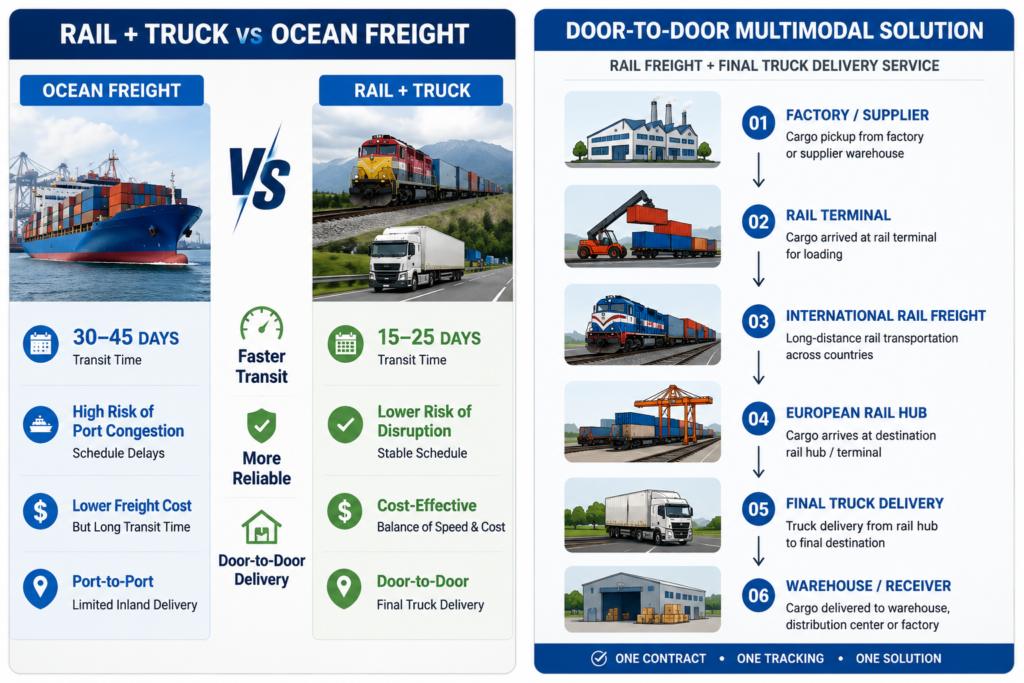
Multimodal transportation combines two or more transportation modes under a coordinated logistics plan. In this model, rail freight handles the long-haul international segment, while trucking completes the final delivery to warehouses, distribution centers, factories, or retail locations.
How Does the Process Work?
| Transportation Stage | Function |
|---|---|
| Cargo Pickup | Supplier collection |
| Rail Transportation | Long-distance international movement |
| Rail Terminal Arrival | Cargo unloading |
| Truck Delivery | Final destination transportation |
| Proof of Delivery | Shipment completion |
Moreover, a single logistics provider often coordinates the entire transportation process.
Why Is This Model Popular?
Additionally, businesses benefit from:
- Faster transit than ocean freight
- Broader delivery coverage
- Lower costs than air freight
- Simplified logistics management
Therefore, multimodal transportation has become an increasingly attractive option for international supply chains.
Why Choose Multimodal Rail Freight with Final Truck Delivery Service?
Businesses often need both transportation efficiency and delivery flexibility. Therefore, combining rail and trucking creates significant operational advantages.
Key Benefits
| Benefit | Business Value |
|---|---|
| Faster Transit | Reduced lead times |
| Door-to-Door Service | Simplified operations |
| Cost Efficiency | Lower logistics expenses |
| Flexible Delivery | Access to inland destinations |
Moreover, trucking allows shipments to reach locations that rail infrastructure cannot directly serve.
How Does It Improve Supply Chains?
Furthermore, multimodal solutions reduce handling complexity and improve shipment visibility.
As a result, businesses gain better control over inventory movement and delivery schedules.
How Does Multimodal Rail Freight with Final Truck Delivery Service Compare with Other Shipping Methods?
Transportation decisions often depend on balancing cost, speed, and service coverage.
| Shipping Method | Transit Time | Cost Level | Delivery Coverage |
|---|---|---|---|
| Air Freight | 3–10 Days | High | High |
| Rail + Truck | 15–25 Days | Medium | High |
| Ocean Freight | 30–45 Days | Low | Medium |
Moreover, rail and truck combinations often provide the best balance for commercial cargo.
When Is Rail + Truck the Best Choice?
Businesses commonly choose this solution when:
- Ocean freight is too slow
- Air freight is too expensive
- Final delivery flexibility is required
- Inventory replenishment is time-sensitive
Therefore, multimodal transportation is ideal for many international commercial shipments.
How Does Final Truck Delivery Improve Rail Freight Efficiency?
Rail networks connect major logistics hubs, but they rarely extend directly to customer facilities. Therefore, final truck delivery is essential for completing transportation.
How Does Trucking Support Last-Mile Delivery?
| Trucking Function | Benefit |
|---|---|
| Warehouse Delivery | Direct cargo receipt |
| Retail Distribution | Faster inventory deployment |
| Factory Delivery | Production continuity |
| Regional Distribution | Expanded market reach |
Moreover, trucking provides flexibility for appointment scheduling and destination changes.
What Challenges Can Trucking Solve?
Additionally, trucking helps overcome:
- Rail network limitations
- Warehouse accessibility issues
- Rural destination requirements
- Time-specific delivery requests
Consequently, businesses enjoy greater logistics flexibility.
Case Study: Multimodal Rail Freight with Final Truck Delivery Service
| Item | Details |
|---|---|
| Origin & Destination | Changsha, China → Lyon, France |
| Cargo | Retail furniture products |
| Transit Time | 18 days rail + 2 days truck delivery |
| Cost | Approximately 35% lower than air freight |
| Transportation Method | Rail freight + final truck delivery |
| Customs Clearance | Documents reviewed before departure |
| Brief Overview | Cargo moved by rail to a European inland terminal and completed delivery through a dedicated trucking network, ensuring on-time inventory replenishment. |
What Documents Are Required for Multimodal Rail Freight with Final Truck Delivery Service?
Documentation accuracy is critical for smooth cargo movement. Therefore, businesses should prepare all required paperwork before shipment departure.
Essential Shipping Documents
| Document | Purpose |
|---|---|
| Commercial Invoice | Customs valuation |
| Packing List | Cargo verification |
| Rail Waybill | Rail transportation record |
| Customs Declaration | Border clearance |
| Delivery Instructions | Final truck delivery guidance |
Moreover, accurate documentation reduces customs delays and delivery disruptions.
How Can Businesses Avoid Documentation Issues?
Additionally, companies should:
- Verify consignee information
- Confirm product descriptions
- Review customs requirements
- Match shipping records across all documents
As a result, shipments move through transportation networks more efficiently.
How Can Businesses Reduce Costs with Multimodal Rail Freight and Truck Delivery?
Cost management remains a key concern for international shippers. Therefore, businesses should evaluate opportunities to optimize transportation spending.
Cost Optimization Strategies
| Strategy | Potential Benefit |
|---|---|
| Cargo Consolidation | Lower transportation cost |
| Early Capacity Booking | Better pricing |
| Route Optimization | Reduced mileage |
| Accurate Documentation | Fewer delay charges |
Moreover, combining rail and trucking often eliminates the need for expensive air freight solutions.
Balancing Cost and Speed
Furthermore, businesses can adjust transportation plans based on delivery priorities and inventory requirements.
Consequently, multimodal transportation provides greater flexibility than single-mode shipping options.
How Should Businesses Choose a Multimodal Rail Freight Provider?
Selecting the right logistics partner significantly impacts transportation performance. Therefore, businesses should evaluate providers beyond pricing alone.
What Capabilities Matter Most?
| Capability | Importance |
|---|---|
| Rail Network Coverage | Route flexibility |
| Trucking Partnerships | Delivery reliability |
| Customs Expertise | Faster clearance |
| Real-Time Tracking | Shipment visibility |
Questions to Ask Before Booking
Additionally, businesses should ask:
- Do you provide door-to-door service?
- Can you manage customs clearance?
- What tracking options are available?
- Do you offer contingency plans for delays?
Therefore, choosing an experienced provider improves service reliability and operational efficiency.
Conclusion
Multimodal rail freight with final truck delivery service combines the speed and efficiency of rail transportation with the flexibility of trucking networks. Moreover, it enables businesses to achieve reliable door-to-door delivery while balancing cost and transit time.
By integrating rail freight, customs coordination, and final-mile trucking, companies can improve supply chain performance, expand delivery coverage, and enhance inventory management. Therefore, multimodal transportation remains one of the most effective logistics solutions for international commercial cargo.
👉 Need a flexible logistics solution that combines international rail transportation with local delivery services?
FAQs
Q1: What is multimodal rail freight with final truck delivery service?
It combines long-distance rail transportation with local trucking to provide efficient door-to-door cargo delivery.
Q2: Is rail and truck transportation faster than ocean freight?
Yes. In many international trade lanes, rail and truck solutions reduce transit times significantly compared with traditional ocean shipping.
Q3: What cargo types are suitable for multimodal rail freight?
Retail inventory, furniture, electronics, industrial equipment, automotive parts, and consumer products are commonly transported using multimodal solutions.
Q4: How does final truck delivery improve logistics efficiency?
Trucking completes delivery from rail terminals to warehouses, factories, and retail locations that rail networks cannot directly reach.
Q5: How can I choose the right multimodal freight forwarder?
Look for providers with rail expertise, trucking partnerships, customs clearance capabilities, and real-time shipment visibility systems.