

Introduction
Why international rail freight shipping costs increased recently has become a major concern for importers, exporters, and supply chain managers. Many companies have noticed that rail freight rates are higher than they were in previous months, even when shipment volumes remain relatively stable.
However, rail freight pricing is influenced by multiple factors beyond simple transportation demand. Rising operational expenses, equipment shortages, route adjustments, and changing market conditions can all contribute to higher shipping costs.
Moreover, understanding these cost drivers helps businesses make better logistics decisions. Therefore, companies that recognize the reasons behind rate increases can plan transportation budgets more effectively and identify opportunities to reduce expenses.
This article explains what is causing recent rail freight cost increases, why businesses are feeling the impact, and how companies can manage transportation spending more efficiently.

What Is Driving Why International Rail Freight Shipping Costs Increased Recently?
Several market factors have contributed to recent rail freight price increases. While some changes are temporary, others reflect long-term developments within international logistics networks.
Major Cost Drivers
| Factor | Impact on Freight Costs |
|---|---|
| Increased Transportation Demand | Higher Capacity Competition |
| Equipment Shortages | Limited Container Availability |
| Fuel and Energy Costs | Higher Operating Expenses |
| Labor Costs | Increased Handling Charges |
| Terminal Congestion | Additional Processing Costs |
| Route Adjustments | Longer Transportation Distances |
Furthermore, many rail operators have faced increasing operational expenses over the past few years. Consequently, transportation providers have adjusted pricing structures to maintain service levels.
Capacity Pressure Across Key Corridors
Demand for rail freight often rises when businesses seek alternatives to ocean or air transportation.
Therefore, when more companies choose rail solutions simultaneously, available capacity becomes tighter and transportation rates naturally increase.
Why Are Businesses Feeling the Impact of Higher Rail Freight Costs?
Although freight rate increases affect most industries, some sectors experience greater pressure than others.
Inventory Costs Are Rising
Higher transportation expenses directly affect product costs.
Moreover, companies importing large shipment volumes may see significant increases in total logistics spending.
Supply Chain Budgets Require Adjustment
Many businesses create annual logistics budgets based on expected transportation rates.
However, sudden freight increases can create budget gaps that require operational adjustments.
Competitive Pressure Continues
Meanwhile, companies must often absorb part of the transportation increase rather than passing all costs to customers.
As a result, profit margins may become tighter.
Industries Most Affected
| Industry | Impact Level |
|---|---|
| Consumer Electronics | High |
| Automotive Components | High |
| Industrial Equipment | Medium-High |
| Retail Products | Medium |
| Construction Materials | Medium |
Consequently, businesses must actively manage freight spending rather than simply accepting higher transportation costs.
How Can Companies Reduce the Impact of Rising Rail Freight Costs?
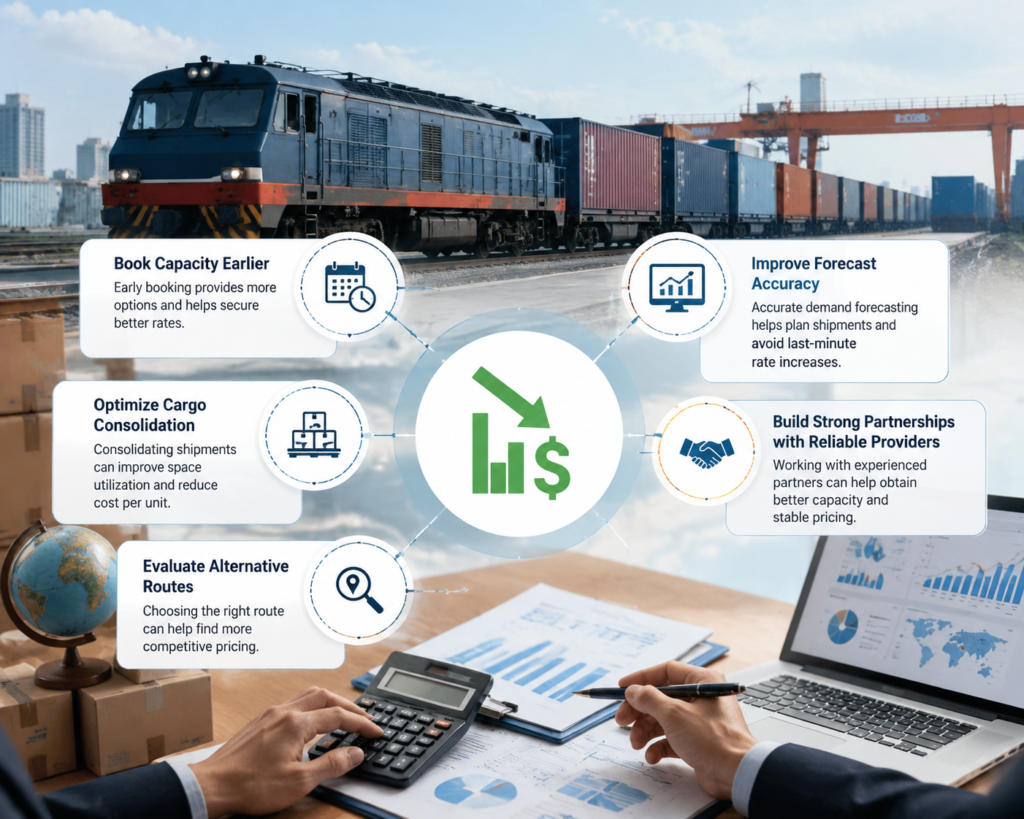
Even when market rates increase, businesses can still control overall logistics expenses through strategic planning.
Book Capacity Earlier
First, early booking often provides access to more transportation options.
Moreover, advanced planning reduces the likelihood of paying premium rates during high-demand periods.
Optimize Cargo Consolidation
Combining multiple shipments into larger loads can improve transportation efficiency.
Therefore, businesses may reduce the cost per unit shipped.
Evaluate Alternative Routes
Some transportation corridors may offer more competitive pricing than others.
Consequently, route flexibility can help companies manage costs.
Improve Forecast Accuracy
Accurate demand forecasting allows logistics teams to secure capacity before market pressure intensifies.
As a result, businesses can avoid emergency transportation expenses.
Cost-Control Strategies
| Strategy | Potential Benefit |
|---|---|
| Early Booking | Better Capacity Access |
| Consolidation | Lower Unit Cost |
| Route Optimization | Improved Cost Efficiency |
| Demand Forecasting | Reduced Emergency Costs |
Furthermore, combining these strategies often produces better results than relying on a single solution.
What Market Challenges Are Contributing to Higher Rail Freight Rates?
Rail freight pricing is closely linked to broader supply chain conditions.
Equipment Availability Challenges
Containers and specialized rail equipment may become limited during periods of strong demand.
Therefore, transportation providers may increase rates to manage available capacity.
Terminal Congestion
Busy terminals often require additional labor and handling resources.
Moreover, longer processing times can increase operating costs.
Regulatory and Customs Changes
Certain regions occasionally introduce new customs requirements or transportation regulations.
Consequently, compliance costs may rise for logistics providers.
Infrastructure Investment Costs
Rail operators continuously invest in:
- Network improvements
- Terminal modernization
- Equipment upgrades
- Digital tracking systems
While these investments improve service quality, they may also contribute to higher operating expenses.
As a result, transportation pricing may gradually increase over time.
Real Cases of Managing Rising Rail Freight Costs
🚆 Project Card 1: Consumer Electronics Cost Optimization
📍 Route: Shenzhen, China → Duisburg, Germany → Rotterdam, Netherlands
📦 Cargo: Consumer Electronics
⏱️ Transit Time: 20 Days Rail + 2 Days Truck Delivery
💰 Cost Impact: Reduced Transportation Cost Increase by 18%
🚄 Mode: Rail Freight + Regional Trucking
🛃 Customs Clearance Details:
Pre-arrival customs document review and coordinated import declaration support.
✅ Outcome:
Maintained product availability without switching to higher-cost air freight.
Overview:
An electronics distributor faced rising rail transportation rates before a major sales season. Therefore, the company consolidated shipments and secured rail capacity earlier, reducing overall logistics costs.
🚆 Project Card 2: Automotive Supplier Route Optimization
📍 Route: Chongqing, China → Warsaw, Poland → Brno, Czech Republic
📦 Cargo: Automotive Components
⏱️ Transit Time: 19 Days Rail + 1 Day Truck Delivery
💰 Cost Impact: Saved Approximately 15% Through Route Changes
🚄 Mode: International Rail Freight + Dedicated Truck
🛃 Customs Clearance Details:
Coordinated customs filing before cargo arrival.
✅ Outcome:
Reduced transportation expenses while maintaining production schedules.
Overview:
An automotive supplier evaluated alternative rail corridors and selected a more efficient route. Consequently, transportation costs remained manageable despite market rate increases.
🚆 Project Card 3: Industrial Equipment Shipment Planning
📍 Route: Wuhan, China → Budapest, Hungary → Belgrade, Serbia
📦 Cargo: Industrial Manufacturing Equipment
⏱️ Transit Time: 22 Days Rail + 2 Days Truck Delivery
💰 Cost Impact: Avoided Peak Season Surcharges
🚄 Mode: Rail Freight + Heavy Equipment Trucking
🛃 Customs Clearance Details:
Documentation preparation completed before departure to prevent delays.
✅ Outcome:
Project delivery remained within budget.
Overview:
A manufacturer advanced shipment schedules by several weeks. As a result, the company secured lower transportation rates before seasonal demand increased.
Rail Freight Rate Information and Cost Trends
Rail freight rates vary according to market demand, route selection, and cargo requirements.
Typical Cost Trend Comparison
| Market Condition | Rate Trend |
|---|---|
| Low Demand Period | Stable |
| Moderate Demand | Slight Increase |
| Peak Season | Higher Increase |
| Capacity Shortage | Significant Increase |
Factors That Influence Freight Pricing
| Pricing Factor | Effect on Cost |
|---|---|
| Capacity Availability | Higher Demand Raises Rates |
| Cargo Volume | Larger Volume Requires More Space |
| Route Popularity | Busy Routes Cost More |
| Equipment Availability | Shortages Increase Pricing |
| Customs Complexity | Additional Service Costs |
Moreover, businesses that regularly review transportation strategies often achieve better long-term cost control.
Conclusion
Why international rail freight shipping costs increased recently can be explained by a combination of higher demand, equipment shortages, rising operating expenses, and ongoing supply chain adjustments.
Moreover, these cost increases are affecting businesses across multiple industries. However, companies can reduce the impact through earlier booking, better forecasting, route optimization, and shipment consolidation.
Therefore, understanding the drivers behind freight pricing helps businesses make smarter logistics decisions and maintain stronger supply chain performance despite changing market conditions.
📊 Ready to improve your transportation cost strategy?
FAQs
1. Are rail freight rates likely to decrease in the future?
Rates depend on market demand, capacity availability, and economic conditions. Therefore, pricing may fluctuate rather than follow a consistent downward trend.
2. Is rail freight still cheaper than air freight?
Yes. In most cases, rail freight remains significantly less expensive than air transportation while offering faster transit than ocean shipping.
3. How can businesses reduce exposure to freight rate increases?
Companies can book earlier, consolidate cargo, evaluate alternative routes, and improve shipment forecasting to manage transportation costs more effectively.
4. Do customs procedures affect rail freight pricing?
Indirectly, yes. Delays or additional compliance requirements can increase handling expenses and overall logistics costs.
5. Which industries are most affected by rising rail freight rates?
Industries with high shipment volumes, such as electronics, automotive manufacturing, and industrial equipment, often experience the greatest impact.